Do I Need to Complete a Self Assessment Tax Return in the UK?
Many people in the UK are unsure whether they need to complete a Self Assessment tax return. This is especially common if you have recently become self-employed, started a side income, received rental income, sold an asset, earned dividends, or received a letter from HMRC.
Self Assessment is the system HM Revenue and Customs uses to collect Income Tax from people whose tax is not fully collected through PAYE. Employees usually have tax deducted automatically from wages or pensions, but people with other income may need to report it through a tax return.
If you need professional help, our Self Assessment tax return accountants in Birmingham can help you check whether you need to file and prepare your return correctly.
What is a Self Assessment tax return?
A Self Assessment tax return is a form used to tell HMRC about your income, expenses, tax reliefs and any tax you owe.
You may need to complete one if HMRC cannot collect all the tax you owe automatically through your employer, pension provider or bank.
Common reasons include:
- being self-employed;
- earning rental income;
- having a side business;
- receiving untaxed income;
- receiving dividends or investment income;
- needing to pay Capital Gains Tax;
- needing to pay the High Income Child Benefit Charge;
- being part of a business partnership.
Who must send a Self Assessment tax return?
You usually need to send a tax return if, in the last tax year, you were self-employed as a sole trader and earned more than £1,000 before expenses, or you were a partner in a business partnership.
You may also need to file if you had to pay Capital Gains Tax, High Income Child Benefit Charge not paid through PAYE, or certain student loan repayments as an off-payroll worker.
You may also need to complete a tax return if you received untaxed income, such as:
- money from renting out a property;
- tips or commission;
- income from savings;
- investment income;
- dividends;
- foreign income.
Do employees need to complete a Self Assessment tax return?
If you are only employed and all your tax is correctly deducted through PAYE, you may not need to complete a Self Assessment tax return.
However, you may still need one if you have other income outside your employment. For example, an employee may need to file a tax return if they also:
- run a side business;
- earn income from online selling, freelancing or content creation;
- rent out property;
- receive large dividends or savings interest;
- have foreign income;
- need to claim certain tax reliefs;
- receive Child Benefit and have income above the High Income Child Benefit Charge threshold.
If HMRC sends you a notice to file a tax return, you should deal with it even if you believe you do not owe tax.
Do I need to file if I have a side hustle?
You may need to register for Self Assessment if your side hustle income is more than £1,000 in a tax year before expenses.
This can include income from activities such as online selling, content creation, dog walking, delivery work, freelance work or property rental.
This does not automatically mean you will pay tax on the full amount. You may be able to deduct allowable expenses or use the trading allowance, depending on your circumstances.
If your side income has become regular self-employed income, our self-employed accountants can help with bookkeeping, allowable expenses, tax calculations and Self Assessment filing.
Do landlords need to complete a Self Assessment tax return?
If you receive rental income from a property, you may need to complete a Self Assessment tax return.
This can apply if you rent out:
- a house;
- a flat;
- a room;
- a commercial property;
- a property abroad.
You should keep records of your rent received, mortgage interest, repairs, insurance, letting agent fees and other property-related expenses.
Landlords often need help with rental income, property expenses, mortgage interest relief and Capital Gains Tax. Gondal Accountancy provides tax support for landlords as part of its Self Assessment tax return service.
What if I earn less than £1,000?
If your trading or property income is below the relevant allowance, you may not need to complete a Self Assessment tax return for that income alone.
There is a tax-free allowance of up to £1,000 each tax year for trading income and property income. If you have both types of income, you may have a £1,000 allowance for each.
However, your full circumstances matter. You may still need to file for another reason, such as Capital Gains Tax, foreign income, partnership income or because HMRC has asked you to file.
What if I receive Child Benefit?
You may need to pay the High Income Child Benefit Charge if you or your partner receives Child Benefit and either of you has adjusted net income above the threshold.
From the 2024 to 2025 tax year onwards, the charge applies where income is over £60,000, and the full amount is repayable where income is £80,000 or more.
If you need to pay the charge and it is not collected through PAYE, you may need to register for Self Assessment.
What if HMRC has asked me to complete a tax return?
If HMRC has sent you a notice to complete a Self Assessment tax return, you should not ignore it.
Even if you believe you do not owe any tax, HMRC may still expect the return unless it agrees to cancel the requirement. Failing to submit it can lead to penalties.
If you have received HMRC correspondence and are unsure what to do next, you can speak to Gondal Accountancy before the deadline.
When do I need to register for Self Assessment?
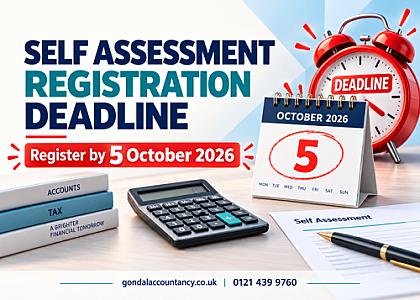
For the 2025 to 2026 tax year, which ran from 6 April 2025 to 5 April 2026, you must tell HMRC by 5 October 2026 if you need to complete a tax return and you have not sent one before, or you previously registered but did not need to send one for 2024 to 2025.
After registering, HMRC will issue your Unique Taxpayer Reference, commonly called a UTR number.
What are the Self Assessment deadlines?
For the 2025 to 2026 tax year, the main deadlines are:
| Task | Deadline |
|---|---|
| Register for Self Assessment | 5 October 2026 |
| Paper tax return deadline | 31 October 2026 |
| Online tax return deadline | 31 January 2027 |
| Pay tax owed | 31 January 2027 |
| Second payment on account, if applicable | 31 July 2027 |
What happens if I miss the deadline?
If you miss the Self Assessment filing deadline, HMRC can issue penalties. The initial late filing penalty is £100. Further penalties can apply after 3 months, 6 months and 12 months.
You may also be charged interest if you pay your tax late.
Our Self Assessment accountants can help you prepare early, organise your records and reduce the risk of late filing penalties.
Can I file a tax return voluntarily?
Yes. You can choose to complete a tax return for certain reasons, such as claiming Income Tax reliefs, proving you are self-employed, or paying voluntary National Insurance contributions.
This can be useful if you need evidence of income for a mortgage, visa application, loan, tax credits, childcare support or other financial matters.
What records should I keep?
You should keep clear records to support your Self Assessment tax return. Depending on your situation, this may include:
- invoices issued;
- receipts for expenses;
- bank statements;
- mileage records;
- rental income records;
- dividend vouchers;
- pension contribution details;
- student loan information;
- details of any tax already paid;
- records of foreign income;
- Capital Gains Tax calculations.
If you run a business, good bookkeeping can make Self Assessment much easier. Gondal Accountancy provides wider accounting and tax support for small businesses including bookkeeping, payroll, VAT and accounts.
Do limited company directors need Self Assessment?
Company directors may need to complete a Self Assessment tax return if they receive dividends, have untaxed income, need to report benefits, or HMRC asks them to file.
If you run a company, your personal Self Assessment is separate from the company’s Corporation Tax return and annual accounts. Our limited company accountants can help with company accounts, Corporation Tax, payroll and director tax matters.
What about VAT and Self Assessment?
VAT is separate from Self Assessment, but many self-employed people and small businesses need support with both. For example, you may need to submit a Self Assessment tax return for your personal income and VAT returns for your business.
If your business is VAT registered, our VAT accountants in Birmingham can help with VAT returns, VAT records and Making Tax Digital compliance.
How do I know for sure if I need to file?
The safest approach is to review your full income position for the tax year. You should consider:
- Were you self-employed?
- Did you earn more than £1,000 from a side income?
- Did you receive rental income?
- Did you sell an asset and make a taxable gain?
- Did you receive foreign income?
- Did you receive dividends or investment income?
- Did HMRC send you a notice to file?
- Do you need to pay the High Income Child Benefit Charge?
- Do you need to claim tax relief or prove self-employed income?
Final answer: do you need to complete a Self Assessment tax return?
You may need to complete a Self Assessment tax return if you have income that HMRC cannot fully tax through PAYE, or if HMRC has asked you to file one.
The most common examples include self-employment, side income over £1,000, rental income, partnership income, Capital Gains Tax, foreign income, dividends, and High Income Child Benefit Charge.
If you are unsure, it is better to check early. Registering late, filing late or paying late can result in penalties and interest.
Need help with your Self Assessment tax return?
Gondal Accountancy provides clear, professional Self Assessment tax return support for individuals, sole traders, landlords, directors and people with untaxed income.
You can also read our client reviews to see what other clients say about our accountancy and tax services.
Disclaimer
The content of this blog is provided for general information purposes only and should not be treated as tax, accounting, legal or financial advice. Tax rules, accounting requirements, legislation, regulations and official guidance can be complex and may change over time. As a result, some information in this article may become outdated, incomplete or no longer applicable after the date of publication.
The application of any tax, accounting or legal rule will depend on your individual or business circumstances. Before making any decision or taking any action based on the information in this article, you should seek advice from a suitably qualified tax professional, accountant, solicitor or financial adviser.
Gondal Accountancy and its staff accept no responsibility or liability for any loss, action taken, or decision made or not made as a result of relying on the information contained in this blog.