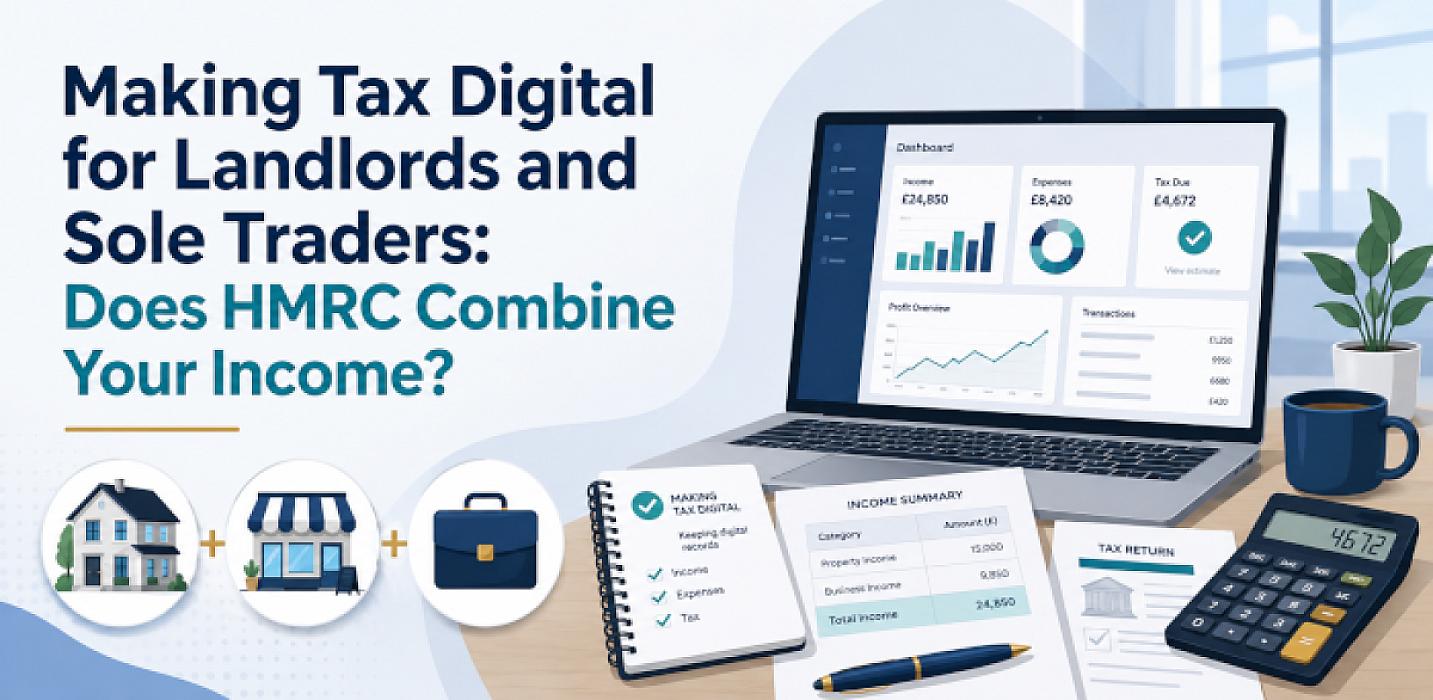
Making Tax Digital for Landlords and Sole Traders: Does HMRC Combine Your Income?
A simple guide for people with rental income, self-employed income, or both
Making Tax Digital for Income Tax is being introduced for many landlords and sole traders.
One common question is:
If you earn money from both property and self-employment, does HMRC look at each income separately?
In most cases, the answer is no. HMRC generally combines your gross rental income and your gross sole-trader income when deciding whether you need to use Making Tax Digital.
What is Making Tax Digital?
Making Tax Digital changes the way some landlords and sole traders keep records and report information to HMRC.
Instead of relying only on one annual Self Assessment tax return, people who fall within the rules will normally need to:
- keep digital records;
- use compatible accounting software;
- send quarterly updates to HMRC; and
- submit final tax information at the end of the year.
The quarterly updates are summaries of income and expenses. They do not usually mean that tax must be paid every three months.
Does HMRC combine rental and sole-trader income?
Yes.
If you are both:
- a landlord receiving rental income; and
- a sole trader earning business income,
HMRC will normally combine both income sources when checking whether Making Tax Digital applies to you.
This means you may need to use Making Tax Digital even where your rental income and business income are each below the limit on their own.
The important point is the total qualifying income from all your self-employed businesses and rental properties.
Is HMRC looking at income or profit?
HMRC normally looks at your gross income, not your profit.
Gross income means the amount received before expenses are deducted.
For a sole trader, this usually means total business sales before costs such as:
- stock;
- fuel;
- wages;
- insurance;
- advertising; and
- accountancy fees.
For a landlord, it usually means total rent received before deducting expenses such as:
- repairs;
- letting-agent fees;
- insurance;
- service charges; and
- property management costs.
Your expenses may reduce the tax you pay, but they do not normally reduce the income HMRC uses to check whether Making Tax Digital applies.
What income is normally included?
HMRC will generally consider income from:
- sole-trader businesses;
- UK rental properties;
- foreign rental properties; and
- other self-employed activities.
If you have more than one business or more than one rental property, the relevant income may be combined.
What income is normally not included?
Some types of personal income do not normally count towards the Making Tax Digital income limit.
These can include:
- salary from employment;
- pension income;
- savings interest;
- dividends;
- State Pension; and
- income received as a partner in a partnership.
These amounts may still need to be included on your tax return, but they are not normally used to decide whether you must join Making Tax Digital.
What if you run a limited company?
A limited company is separate from you personally.
The company’s sales are not normally added to your personal rental income for Making Tax Digital for Income Tax.
Salary and dividends received from your company also do not normally count towards your qualifying income.
However, rental income from property owned in your personal name may still count.
This is different from working as a sole trader, where your business income is personal income and is included.
What about jointly owned property?
If you own a rental property jointly with someone else, HMRC will usually consider your share of the rental income.
For example, where two people own a property equally, each person would normally report their own share.
The correct treatment can depend on how the property is legally and beneficially owned, particularly for married couples and civil partners.
Will all income be reported together?
Your income may be combined when HMRC checks whether Making Tax Digital applies.
However, your records may still need to be kept separately.
For example, you may need separate records for:
- your sole-trader business;
- your UK property income; and
- your foreign property income.
Your accounting software should help you keep each activity organised while allowing the correct information to be reported to HMRC.
When will Making Tax Digital apply?
Making Tax Digital for Income Tax is being introduced in stages.
The starting date will depend on your qualifying income and the information shown on your earlier Self Assessment tax returns.
HMRC may write to you if its records show that you are required to join.
However, landlords and sole traders should not rely only on receiving a letter. It is sensible to check your income and prepare in advance.
How should landlords and sole traders prepare?
If you receive rental income, self-employed income, or both, you should:
- review your total gross income;
- check whether more than one income source must be combined;
- keep your bookkeeping up to date;
- start using digital records;
- keep business and personal transactions separate;
- choose suitable Making Tax Digital software; and
- speak to an accountant before the rules apply to you.
Starting early can help prevent missing records, software problems and last-minute pressure.
The main point
HMRC generally combines gross rental income and sole-trader income when deciding whether you must use Making Tax Digital.
Your expenses and taxable profit are not normally used to check whether you meet the income limit.
Employment income, pensions, savings interest and dividends do not normally count towards the Making Tax Digital threshold.
Even though your income is combined for checking the limit, you may still need to keep separate digital records for each business and property activity.
Need help with Making Tax Digital?
Gondal Accountancy can help landlords and sole traders prepare for Making Tax Digital.
Our services include:
- checking whether Making Tax Digital applies to you;
- reviewing rental and self-employed income;
- setting up digital bookkeeping records;
- selecting suitable accounting software;
- preparing quarterly updates; and
- completing Self Assessment tax returns.
Contact Gondal Accountancy for support with Making Tax Digital, landlord accounts and sole-trader tax returns.
This article provides general information only. Tax rules and HMRC guidance may change, and advice should be based on your individual circumstances.
Disclaimer
The content of this blog is provided for general information purposes only and should not be treated as tax, accounting, legal or financial advice. Tax rules, accounting requirements, legislation, regulations and official guidance can be complex and may change over time. As a result, some information in this article may become outdated, incomplete or no longer applicable after the date of publication.
The application of any tax, accounting or legal rule will depend on your individual or business circumstances. Before making any decision or taking any action based on the information in this article, you should seek advice from a suitably qualified tax professional, accountant, solicitor or financial adviser.
Gondal Accountancy and its staff accept no responsibility or liability for any loss, action taken, or decision made or not made as a result of relying on the information contained in this blog.