What Records Should Sole Traders Keep for HMRC?
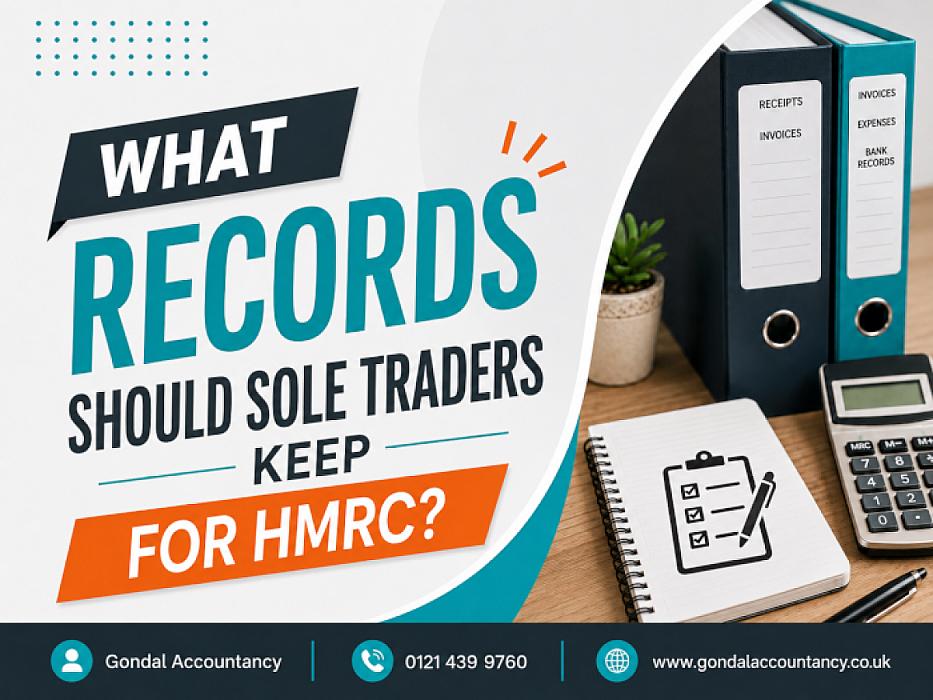
If you are a sole trader, keeping proper records is not optional. Good records help you complete your Self Assessment tax return correctly, claim the right expenses and respond to HMRC if your return is checked.
HMRC states that sole traders and business partners must keep records of business income and expenses for their Self Assessment tax return. You also need to keep records of personal income.
What records should sole traders keep?
HMRC guidance says self-employed people need to keep records of all sales and income, all business expenses, VAT records if registered for VAT, PAYE records if they employ people, records of personal income, and grant records where relevant.
In practical terms, sole traders should keep:
- Sales invoices
- Receipts
- Bank statements
- Cash records
- Supplier invoices
- Mileage records
- Business expense receipts
- Insurance documents
- Loan or finance agreements
- Stock records
- Payroll records, if employing staff
- VAT records, if VAT registered
- UTR and HMRC correspondence
Why are records important?
You do not usually send all your records to HMRC when filing your tax return. However, HMRC can ask to see them if they check your return. HMRC says records are needed to work out profit or loss and to show HMRC if asked.
Without proper records, you may:
- Miss allowable expenses
- Overpay tax
- Underreport income by mistake
- Struggle to prove business costs
- Face stress if HMRC asks questions
Cash and bank payments
If customers pay by cash, card, bank transfer or online platforms, all income must be recorded. Cash income should not be ignored simply because it does not appear directly in the bank account.
A good system should match invoices, payments and bank deposits.
How long should records be kept?
HMRC says self-employed people must keep records for at least five years after the 31 January submission deadline for the relevant tax year. For example, if a 2022 to 2023 tax return was submitted online by 31 January 2024, records must be kept until at least the end of January 2029.
Should sole traders use bookkeeping software?
Bookkeeping software can make record keeping much easier. It can help with invoices, expenses, bank feeds, VAT, profit reports and tax return preparation.
This is also becoming more important because MTD for Income Tax is being phased in for sole traders and landlords, depending on qualifying income.
Need help with sole trader accounts?
Gondal Accountancy can help sole traders organise records, prepare Self Assessment tax returns, claim allowable expenses and stay compliant with HMRC.
Disclaimer
The content of this blog is provided for general information purposes only and should not be treated as tax, accounting, legal or financial advice. Tax rules, accounting requirements, legislation, regulations and official guidance can be complex and may change over time. As a result, some information in this article may become outdated, incomplete or no longer applicable after the date of publication.
The application of any tax, accounting or legal rule will depend on your individual or business circumstances. Before making any decision or taking any action based on the information in this article, you should seek advice from a suitably qualified tax professional, accountant, solicitor or financial adviser.
Gondal Accountancy and its staff accept no responsibility or liability for any loss, action taken, or decision made or not made as a result of relying on the information contained in this blog.