Bookkeeping Tips for Shopify and TikTok Shop Sellers
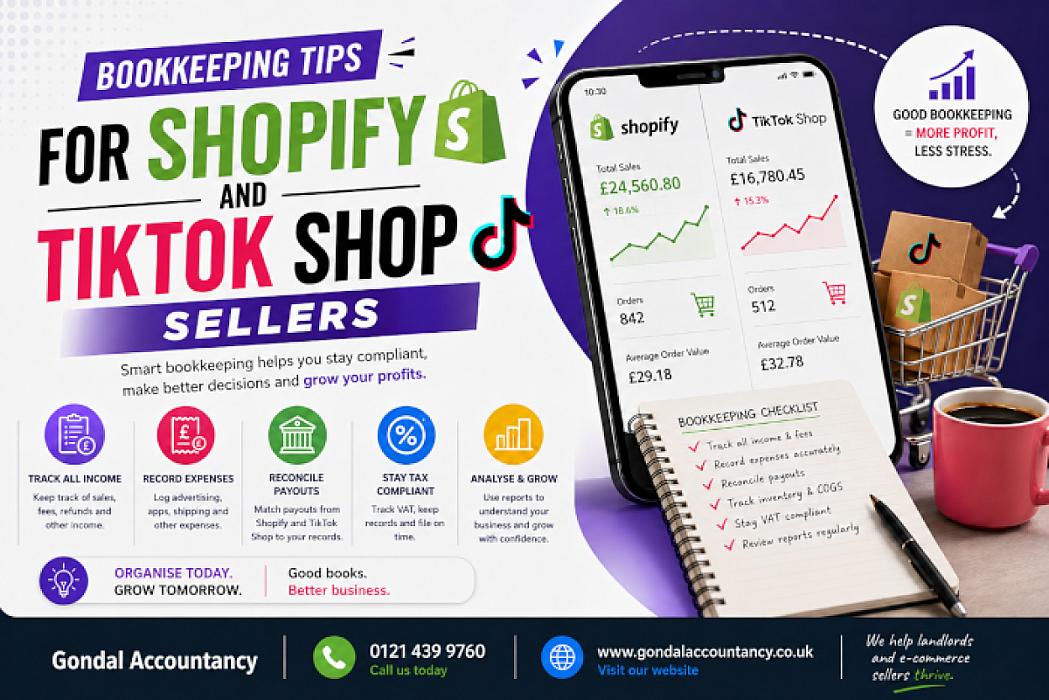
Selling through Shopify and TikTok Shop can be a great way to grow an online business, but bookkeeping can quickly become confusing if your sales, refunds, platform fees, stock purchases and payment payouts are not recorded properly.
Many online sellers make the mistake of looking only at the money landing in their bank account. However, your bank payout is not the same as your total sales. Shopify, TikTok Shop and payment processors may deduct fees, refunds, shipping costs, advertising costs or other charges before the money reaches your account.
Good bookkeeping helps you understand your real profit, prepare your tax return, manage VAT correctly and avoid problems with HMRC.
If you need help keeping your records organised, Gondal Accountancy provides bookkeeping services for small businesses, including support with digital records, bank reconciliation, invoices, expenses and management reports.
Why bookkeeping matters for online sellers
Bookkeeping is the process of keeping accurate records of your business income and expenses.
If you sell online, you may have income and costs coming from several places, including:
- Shopify sales;
- TikTok Shop sales;
- PayPal, Stripe or other payment gateways;
- platform fees;
- card processing fees;
- refunds and chargebacks;
- stock purchases;
- packaging costs;
- delivery and courier charges;
- advertising costs;
- influencer payments;
- software subscriptions;
- website and app costs.
HMRC says sole traders and business partners must keep records of business income and expenses for their Self Assessment tax return. These records should include all sales, all business expenses, VAT records if registered for VAT, PAYE records if employing people, and records of personal income.
For sole traders and self-employed online sellers, our self-employed accountants can help with Self Assessment, bookkeeping, tax calculations, HMRC deadlines and digital accounting support.
Do not record only the bank payout
One of the most common bookkeeping mistakes for Shopify and TikTok Shop sellers is recording only the amount paid into the bank.
For example, if you sell £1,000 of products and the platform deducts £80 in fees before sending you £920, your sales are not £920. Your gross sales may be £1,000, and the £80 should usually be recorded separately as a business expense.
A better bookkeeping method is to record:
| Item | Example |
|---|---|
| Gross sales | £1,000 |
| Refunds | -£100 |
| Platform/payment fees | -£80 |
| Net payout to bank | £820 |
This gives a clearer picture of turnover, expenses and profit.
Separate Shopify and TikTok Shop sales
If you sell on both platforms, keep the sales records separate. This helps you understand which platform is actually profitable.
For each platform, track:
- gross sales;
- refunds;
- discounts;
- platform fees;
- payment processing fees;
- shipping income;
- shipping costs;
- advertising spend;
- net payout received.
This makes it easier to compare performance. For example, Shopify may have higher direct sales but higher ad spend, while TikTok Shop may have lower customer acquisition costs but higher discounts or creator commission.
Keep records of refunds and returns
Refunds and returns are common in e-commerce, especially for fashion, beauty, accessories and consumer products.
You should record refunds separately instead of simply reducing your bank income. This helps you understand:
- how much you are losing through returns;
- which products have the highest refund rate;
- whether sizing, quality or delivery issues are affecting profit;
- whether your platform sales reports match your bank deposits.
Good returns tracking can also help you decide whether certain products are worth continuing.
Track platform fees and payment fees
Shopify and TikTok Shop sellers often pay different types of fees. These may include:
- transaction fees;
- payment processing fees;
- referral fees;
- commission fees;
- subscription fees;
- app fees;
- creator or affiliate commission;
- fulfilment or delivery-related fees.
These costs can reduce profit significantly. If they are not recorded properly, your accounts may show a misleading profit figure.
You should download monthly statements from each platform and reconcile them against your bank account.
Keep stock records properly
Stock is one of the most important areas of bookkeeping for product-based sellers.
You should keep clear records of:
- stock purchased;
- supplier invoices;
- import costs;
- customs duty;
- delivery charges;
- packaging materials;
- stock held at the end of the year;
- damaged or unsellable stock;
- samples or giveaways.
Do not assume all stock purchases are immediately your profit loss. Unsold stock may still be an asset of the business, so it needs to be treated correctly in your accounts.
Understand your real profit margin
Many online sellers focus on sales volume, but high sales do not always mean high profit.
For each product, calculate:
| Cost | Example |
|---|---|
| Selling price | £30.00 |
| Product cost | £10.00 |
| Platform/payment fees | £3.00 |
| Packaging | £1.00 |
| Delivery | £4.00 |
| Advertising cost per sale | £5.00 |
| Estimated profit | £7.00 |
Without this calculation, you may sell large volumes but make very little profit.
Keep business and personal spending separate
Use a separate business bank account where possible. This makes bookkeeping much easier and reduces the risk of missing income or expenses.
Avoid mixing:
- personal shopping;
- household bills;
- personal transfers;
- business sales income;
- supplier payments;
- advertising spend.
If you are a sole trader, a separate business bank account is still highly recommended, even if it is not legally required in the same way as a limited company account.
If your online selling business is growing, our sole trader accountants in Birmingham can help you organise records, expenses, Self Assessment and Making Tax Digital preparation.
Save all supplier invoices and receipts
You should keep invoices and receipts for business purchases, including:
- stock;
- packaging;
- postage;
- courier services;
- website costs;
- apps and software;
- advertising;
- equipment;
- phone and internet costs;
- professional fees;
- storage costs;
- office supplies.
HMRC can ask to check records, so you need evidence to support the figures in your accounts. Self-employed people must generally keep records for at least 5 years after the 31 January submission deadline for the relevant tax year.
Watch the VAT registration threshold
VAT is a key issue for growing Shopify and TikTok Shop sellers.
You must register for VAT if your total taxable turnover for the last 12 months goes over £90,000. You usually need to register within 30 days of the end of the month when you went over the threshold.
You may also need to register if you expect your turnover to go over the threshold in the next 30 days.
For online sellers, this threshold can be reached quickly, especially during seasonal sales, viral TikTok campaigns or successful product launches.
Gondal Accountancy can help with VAT returns and Making Tax Digital support, including VAT payment references, VAT deadlines and HMRC payment guidance.
Do not wait until year-end
Bookkeeping should be done regularly, not only once a year.
A good routine is:
- weekly: check sales, refunds and bank payouts;
- monthly: download platform statements and reconcile fees;
- quarterly: review profit, VAT position and stock levels;
- yearly: prepare final accounts and tax return.
Leaving everything until January can lead to missing invoices, incorrect figures and unnecessary stress.
If you need help preparing your return, our Self Assessment tax return accountants can help you prepare accurate returns, identify allowable expenses and submit to HMRC on time.
Reconcile your platform reports with your bank
Each month, compare your Shopify and TikTok Shop reports with the money received in your bank account.
You should check:
- sales match platform reports;
- refunds are recorded;
- fees are recorded;
- payout dates match bank deposits;
- chargebacks are included;
- advertising costs are not missed;
- payment processor balances are cleared correctly.
This is especially important because platform sales may happen on one date, but the payout may reach your bank later.
Keep track of advertising costs
Shopify and TikTok Shop sellers often spend money on:
- TikTok Ads;
- Meta/Facebook Ads;
- Google Ads;
- influencer marketing;
- creator commission;
- product samples;
- video content;
- photography;
- email marketing tools.
Advertising can be one of the biggest costs for online sellers. Track it carefully so you know your real cost per sale.
Use bookkeeping software
Bookkeeping software can save time and reduce errors. Many sellers use systems that connect to their bank, Shopify, Stripe, PayPal and accounting software.
Good software can help you:
- import sales data;
- categorise expenses;
- reconcile bank transactions;
- track VAT;
- produce reports;
- prepare for Self Assessment or company accounts;
- keep digital records.
Gondal Accountancy can help businesses move to cloud accounting software and organise bookkeeping. For example, our FreeAgent accountants support businesses with cloud accounting and clearer digital records.
Limited company sellers
Some Shopify and TikTok Shop sellers operate through a limited company instead of as a sole trader.
If you trade through a company, your bookkeeping needs to separate company money from personal money. You may also need to deal with:
- annual accounts;
- Corporation Tax;
- director salary;
- dividends;
- payroll;
- VAT;
- Companies House filings;
- director Self Assessment.
Our limited company accountants in Birmingham can help with company accounts, CT600 Corporation Tax returns, payroll, VAT and director tax matters.
Common bookkeeping mistakes Shopify and TikTok sellers make
Common mistakes include:
- recording only net bank payouts;
- ignoring platform fees;
- not tracking refunds separately;
- mixing personal and business spending;
- not keeping supplier invoices;
- missing advertising costs;
- treating all stock purchases incorrectly;
- not checking VAT registration early enough;
- failing to reconcile platform reports;
- leaving bookkeeping until the tax deadline.
These mistakes can lead to inaccurate profit figures, unexpected tax bills and HMRC issues.
Monthly bookkeeping checklist for online sellers
Use this simple checklist each month:
- Download Shopify sales report.
- Download TikTok Shop sales report.
- Download payment processor statements.
- Record gross sales.
- Record refunds and chargebacks.
- Record platform and payment fees.
- Reconcile payouts to the bank.
- Upload stock invoices and receipts.
- Record advertising costs.
- Check VAT taxable turnover.
- Review profit by product or platform.
- Save all records securely.
When should Shopify and TikTok Shop sellers speak to an accountant?
You should consider speaking to an accountant if:
- your sales are growing quickly;
- you are close to the VAT threshold;
- you sell on multiple platforms;
- you import goods from overseas;
- you have large stock purchases;
- you are unsure whether to trade as a sole trader or limited company;
- your bookkeeping records are messy;
- you have received letters from HMRC;
- you need help with Self Assessment, VAT or company accounts.
An accountant can help you structure your records correctly, claim allowable expenses, prepare tax returns and understand your real profit.
You can also read our client reviews to see what other clients say about Gondal Accountancy’s accounting and tax services.
Need help with bookkeeping for Shopify or TikTok Shop?
Gondal Accountancy helps online sellers, sole traders and small businesses with bookkeeping, Self Assessment, VAT, payroll and accounts.
Whether you sell through Shopify, TikTok Shop, Amazon, eBay or your own website, keeping accurate records is essential for tax compliance and business growth.
Disclaimer
The content of this blog is provided for general information purposes only and should not be treated as tax, accounting, legal or financial advice. Tax rules, accounting requirements, legislation, regulations and official guidance can be complex and may change over time. As a result, some information in this article may become outdated, incomplete or no longer applicable after the date of publication.
The application of any tax, accounting or legal rule will depend on your individual or business circumstances. Before making any decision or taking any action based on the information in this article, you should seek advice from a suitably qualified tax professional, accountant, solicitor or financial adviser.
Gondal Accountancy and its staff accept no responsibility or liability for any loss, action taken, or decision made or not made as a result of relying on the information contained in this blog.