Why Is My First Self Assessment Tax Bill So High?
First Self Assessment bill higher than expected? See how HMRC payments on account work, what’s due on 31 January 2027 and when you can reduce them.
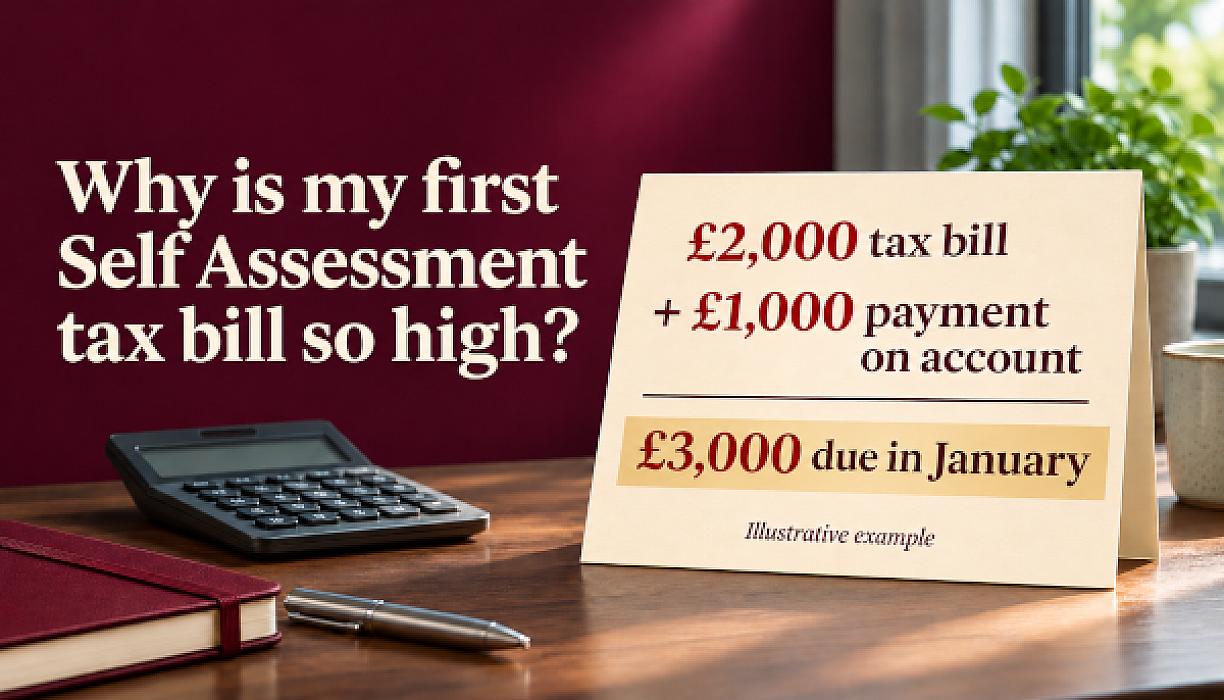
If you expected to pay £2,000 after filing your first Self Assessment tax return and HMRC is asking for £3,000, check whether your bill includes a payment on account. Your January payment can include the tax you owe for the year you’ve just filed and an advance payment towards the following year’s bill. GOV.UK
For most people filing a 2025/26 Self Assessment tax return, the online filing and tax payment deadline is 31 January 2027. If payments on account apply, the first instalment for 2026/27 is due on the same date. The second is due on 31 July 2027. GOV.UK
What are payments on account?
Payments on account are advance instalments towards your next Self Assessment bill. HMRC usually calculates each instalment at half the previous year’s relevant tax liability. For self-employed people, this can include Class 4 National Insurance. When you file your next return, HMRC credits the instalments against the amount you owe for that year. GOV.UK
How a £2,000 tax bill can become a £3,000 January payment
Suppose you’re a sole trader filing your first return for 2025/26. Your tax calculation shows £2,000 due, and HMRC calculates two payments on account of £1,000 each for 2026/27. Here’s how the payments break down. GOV.UK
| Due date | What you’re paying | Amount |
|---|---|---|
| 31 January 2027 | Tax owed for 2025/26 | £2,000 |
| 31 January 2027 | First payment on account for 2026/27 | £1,000 |
| Total due in January | £3,000 | |
| 31 July 2027 | Second payment on account for 2026/27 | £1,000 |
If your final bill for 2026/27 comes to £2,400, your two £1,000 instalments leave a £400 balancing payment. That amount would normally be due by 31 January 2028, alongside any first payment on account due for 2027/28. GOV.UK
Does everyone have to make payments on account?
HMRC generally requires payments on account unless your previous year’s relevant tax bill was under £1,000 or you paid more than 80% of the tax you owed outside Self Assessment, for example through PAYE. Check your Self Assessment statement or online account for the amounts and dates that apply to you. GOV.UK
Can you reduce your payments on account?
You can ask HMRC to reduce your payments on account if you reasonably expect to owe less tax this year. For example, your profits may have fallen, you may be entitled to more tax relief, or more tax may already be deducted from your income. Use your records to estimate what you’ll owe. If you reduce the instalments too far, HMRC can charge interest on the shortfall. You can apply online or by post. GOV.UK
What should you check before paying HMRC?
- Open your Self Assessment statement and identify the amount due by 31 January.
- Check how much relates to 2025/26 and how much is an advance payment for 2026/27.
- Note the July instalment and include it in your budget.
- If your income or profits have fallen, work out whether a reduction is appropriate before applying.
Still gathering paperwork for your return? Start with our 2025/26 Self Assessment documents checklist.
Need help with your first Self Assessment tax return?
Gondal Accountancy helps sole traders and individuals in Birmingham and across the UK prepare and submit their tax returns. If your first bill is higher than expected or you want to understand what’s due before you file, speak to our Self Assessment accountants or call 0121 439 9760. gondalaccountancy.co.uk
Disclaimer
The content of this blog is provided for general information purposes only and should not be treated as tax, accounting, legal or financial advice. Tax rules, accounting requirements, legislation, regulations and official guidance can be complex and may change over time. As a result, some information in this article may become outdated, incomplete or no longer applicable after the date of publication.
The application of any tax, accounting or legal rule will depend on your individual or business circumstances. Before making any decision or taking any action based on the information in this article, you should seek advice from a suitably qualified tax professional, accountant, solicitor or financial adviser.
Gondal Accountancy and its staff accept no responsibility or liability for any loss, action taken, or decision made or not made as a result of relying on the information contained in this blog.